Bob Aufuldish at Play No. 2
“In 1987 when my wife Kathy Warinner and I moved from Ohio to San Francisco, we took the southern route across the country—it was, after all, February. One evening last November I was curious what the northern route would be so I used Google Maps to follow the freeways across the country as a way of reenacting the trip. In our 1987 trip we tried as much as possible to stay off the interstates so when I was conducting my virtual reenactment I did the same. And I came across a place called Little America in Wyoming. Fascinated, I took a photo of it off my screen and started looking for more interesting places. Solitude, Mt. Olympus, Nixon, and Last Chance followed and I was hooked.
“For the past few years I’ve designed new years announcements for the landscape architects SWA Group and for their 2012 announcement I pitched the idea of evocative place names. These are juxtaposed with landscapes of various kinds—the desert, mountains, agriculture, and the sprawl of cities and suburbs. All photographed off my monitor, visited without leaving my office.
“It was a great project. I even found a place in West Virginia called Bob.”
Bob Aufuldish is a Bay Area designer and educator. We invited him to share another moment of play with us.
Greg Clarke at Play
“Each year, I’m asked by editor/designer Monte Beauchamp to create a sequential comic for BLAB, his idiosyncratic paean to the graphically unorthodox. He’s been curating these anthologies more or less every year since 1986, and I’ve had the honor of contributing since 2000. It’s a welcome respite from my usual grind of editorial illustration. I’m given only a general theme and 2–4 pages to write and draw whatever I want. No sketches, no revisions, no committee approvals—just a deadline to deliver finished art.
“This year’s theme is ‘the hereafter.’ I wanted to create a character who is skeptical of the notion of an afterlife, yet amuses himself by imagining he is receiving signs from the dead. The title is Dispatches From Oblivion. This issue of BLAB (newly rechristened BLAB WORLD and now printing in hardcover) will be published this Fall by Last Gasp/San Francisco.”
Greg Clarke is a Southern California illustrator and recovering graphic designer. We invited him to share a moment of play with us.
Emily McVarish at Play
“A Thousand Several is a letterpress book which I wrote and produced for Granary Books and exhibited at 871 Fine Arts last fall. My plan had been to design A Thousand Several as I went along, printing one element and then responding to that element with a new compositional layer. I had thought this would be a liberating exercise, an alternative to the master planning that books tend to demand, a way to make the most of workshop epiphanies.
“In fact, the process often proved fraught, as I attempted to build a graphic system in the dark. ‘What sort of constraints will I be setting myself if I add this?,’ I kept asking myself, ‘How will the dynamics I’ve established be affected by another component?’ I muddled through, and after a year of printing I had my book. I also had a pile of make-ready sheets and a list of design ideas that had not made it through the gauntlet of unknowns that riddled each stage of A Thousand Several’s production.
“One of those ideas finally led me to play: Using a tabbed die, I cut my make-ready into strips of variable widths that could be combined in more than one way to add up to a standard size. I laid all of the strips out on my work table and set about composing Piece-time, an edition of 50 modular collages. Lifting strips from among hundreds of visible variations, laying them alongside each other, sliding them into different arrangements, I felt like I was playing an instrument. Improvisation came easily. Rhythm more than judgment drove and decided the composition of each print.”
Emily McVarish is a San Francisco writer, designer, book artist, and educator. We invited her to share a moment of play with us.
dress code at Play
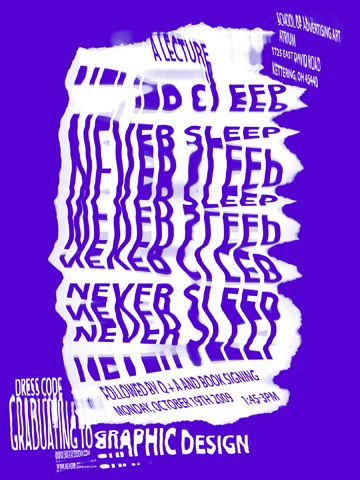
“Our company began out of a shared love for music. We started by collaborating on screen printed posters and package designs for our friends’ bands in college. These jobs never really paid much, if anything, and were more for the fun of making.
“As our business and client list grew, we sadly had less and less time to devote to these projects. Without this creative outlet though, our other work began to get a bit stale.
“To combat the seriousness of corporate clients we started to create a series of one-color screen printed posters to advertise our lectures. We pay to have them printed out-of-pocket, so we have complete creative control. Without the constraints of client approval, the posters have become a way for us to play and experiment.”
Andre Andreev and Dan Covert are New York designers and CCA alumni. We invited them to share a moment of play with us.
Michael Schwab at Play
“David Sedaris’ agent called me with a request. Because David has never been comfortable with the publicity photos for his book tours and speaking engagements, he wanted me to create a logo he could use in lieu of a head shot. His concept was clear and succinct: ‘A monkey reading a book.’
“I immediately began studying monkeys—the way they sit, the way they hold objects, their tails, their postures. The David Sedaris Monkey is a simple, bold, graphic icon of which I’m proud. The process was fun and, like a good book, I didn’t want it to end. David likes it, too.”
Michael Schwab is a Bay Area illustrator and designer. We invited him to share a moment of play with us.
Dennis Crowe at Play
Dennis Crowe’s “Top of the Hour” :20 Spot for MTV (3:00)
The original 1994 spot and the process of making it.
“When I consider the concept of play as it relates to the many projects I have designed throughout my career, one project in particular leaps out: the ‘Top of the Hour’ spot I designed and directed for MTV. Although this project is many years old and long gone from the airwaves, with play as the theme I couldn’t resist dusting this one off from the archives.
“I immediately knew I wanted to use a clock as the central theme and play with the idea of using the numbers on the clock as letterforms to spell out the MTV tag line ‘Plug In.’ I soon realized that by using the M from the MTV logo as the 3 on the clock I could bookend the spot with this visual trick.
“The fact that the spot was going to be broadcast repeatedly every hour on the hour gave me the excuse to overload it with visual activity so that jaded channel surfers would not get bored with multiple viewings. It became an opportunity to play with the collective attention span of a generation.
“Inspired by the dark, dreamlike, imaginative art of Mark Ryden and with trademark ‘blendo’ animation style in mind, I developed the storyboards. With the support of the fantastic production, animation, and technical crew at Colossal, we combined replacement animation, stop motion animation, live action, and archival footage into a frenetically paced explosion of imagery. Colossal Pictures’ Jenny Head, the world-class producer, made sure that I got everything I wanted including a circus performer, a rocket ship, and live animals. It took us 60 days to craft the :20 spot. I never played so hard at work in my life.”
Director: Dennis Crowe; Production Company: Colossal Pictures; Producer: Jenny Head; Technical Director: Peter Williams; Animator: Trey Thomas; Director of Photography: Don Smith; Set Design Elements: John Pappas; Set Production: Jamie Hyneman.
Dennis Crowe is a Bay Area designer and educator. We invited him to share a moment of play with us.
Steve Lyons at Play
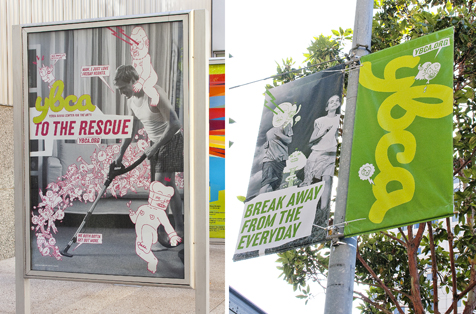
“For this net neutrality mark I made for CREDO Action, I was attempting to take a geeky tech policy issue and make it playful. The essential idea behind net neutrality is one of keeping the internet open and free from corporate control. (For more on the topic I suggest you visit Save The Internet). How better to convey freedom than to give the internet some wings? Lightning bolts add a little zap to the composition and complete the labor union retro feel. CREDO took the playfulness a little farther and made temporary tattoos as a giveaway at the progressive blogger conference Netroots Nation.”
Steve Lyons is Design Director of CREDO Mobile. We invited him to share a moment of play with us.
Vivienne Flesher at Play
“We had two weeks in Round Hill, a lavish and historic resort in Jamaica. While there I tried drawing and painting, but in the heat and humidity both seemed slow and complicated. On the third day I came across the fallen leaves of a Trumpet Tree. To me they resembled dresses by Issey Miyake, tossed in a heap. Over the rest of the vacation I photographed them hundreds of times. They were intrinsically elegant; shooting them the simplest way worked best.”
Vivienne Flesher is a San Francisco artist. We invited her to share a moment of play with us.
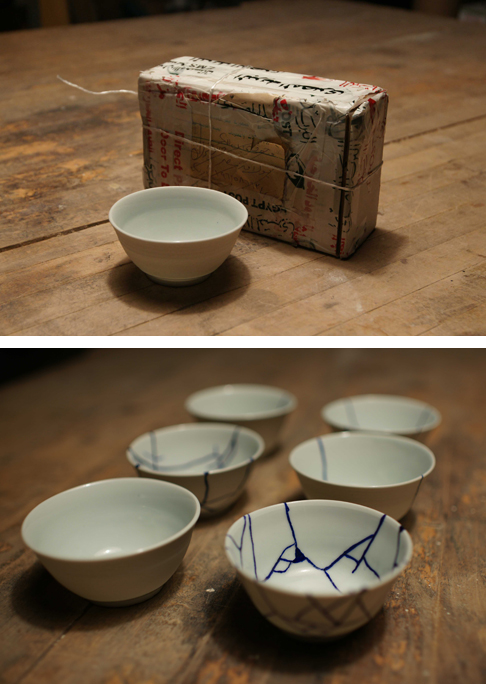
Ward Schumaker at Play
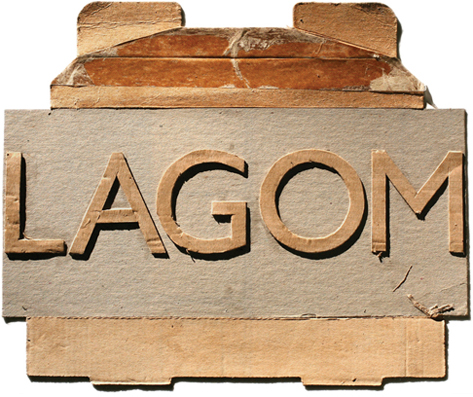
“While creating a piece of calligraphy for Afar Magazine, I’d cut a mask out of cardboard for the Swedish word lagom (meaning just enough, the opposite of excessive and extravagant), intending to use the mask as part of an elaborate Photoshop file combined with other images. When I turned to sweep the scraps from the floor, however, the afternoon sun was shining on them and they looked so genuine and honest, and somehow so appropriate, that I straightened them and photographed them just like that, and that’s how the piece appeared in the magazine. Very lagom.”
Ward Schumaker is a San Francisco artist. We invited him to share a moment of play with us.
Bob Aufuldish at Play
“With the poster I was trying to solve the formal problem of making type read on top of an image. One classic rule of typography is to never put a stroke on the type. But what happens if you specify a huge stroke? All kinds of interesting bumpy shapes result. I made the bumpy shapes silver and set them to partially overprint the image underneath so the silver acts as a connector between the image and the type.
“Photos of three speakers were superimposed to create the image. Each photo was assigned one process color: cyan, magenta, yellow. Usually there is an overall theme for the lecture series but this time there wasn't. There was much discussion as to whether or not to show small versions of the individual photos as a way of explaining the source of the images on the poster, but I prefer not to explain anything. I like it much better when you're not sure what you're looking at rather than wondering briefly and then knowing exactly.
“I made the video literally just for fun. I like to make videos where nothing much seems to happen. In this case, there are four videos where nothing much seems to happen, but putting them in a sequence sparks a little narrative.”
Bob Aufuldish is a Bay Area designer and educator. We invited him to share a moment of play with us.
Bob Aufuldish on press (2:02)
Printing the Fall 2010 CCA Architecture Lecture Series poster at Howard Quinn in San Francisco.